
Powder metallurgy (PM) is a manufacturing process that turns metal powder into solid, precision components by pressing and heating. If you have ever wondered how a gear with splines, keyways and an oil pocket can cost less than a simple machined disc, powder metallurgy is the answer.
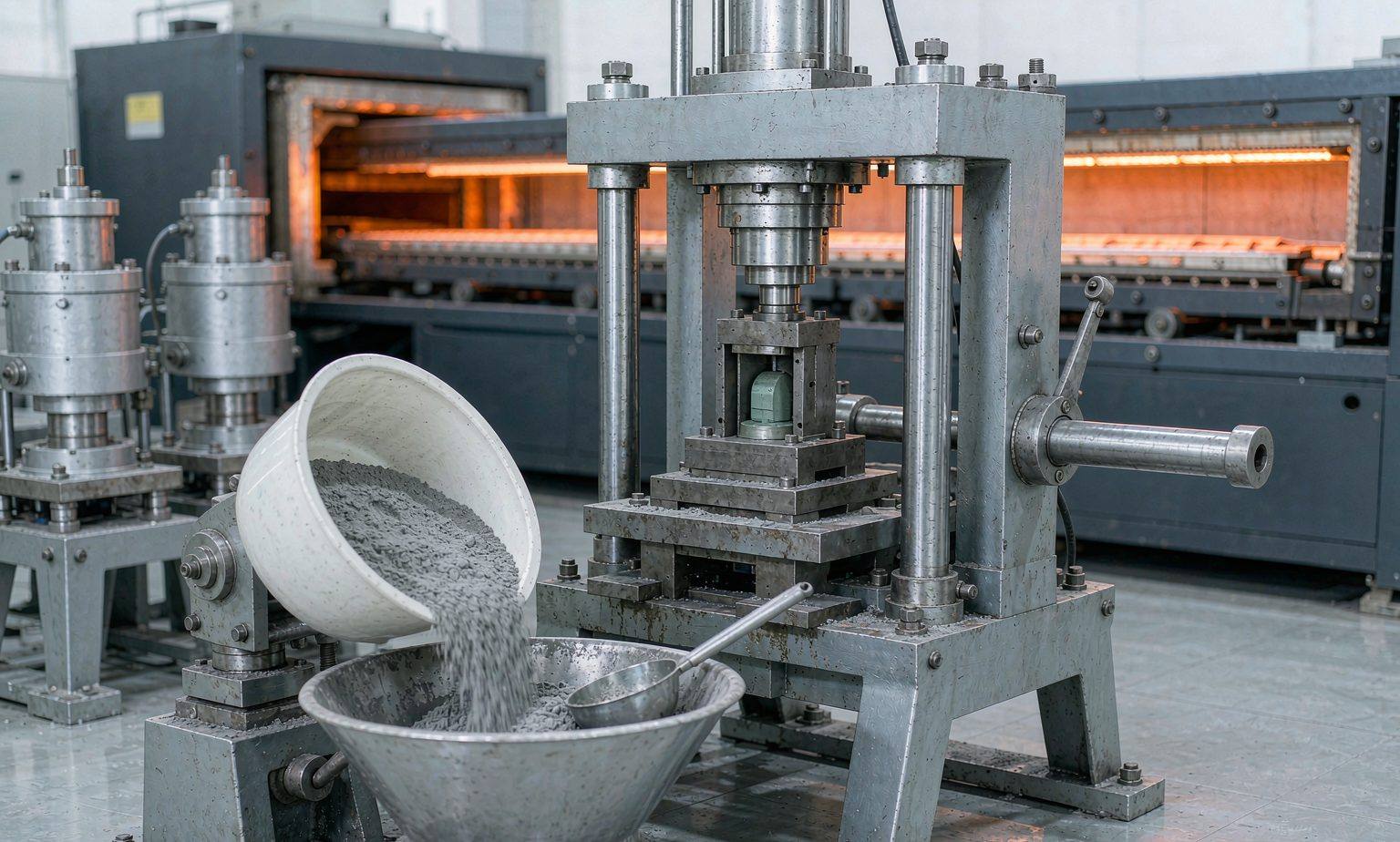
The Four Basic Steps
1. Mixing
Fine metal powder – usually atomized iron, steel, stainless steel, bronze or a soft magnetic alloy – is blended with lubricant and, where needed, alloying additions such as copper, nickel, graphite or phosphorus. Consistent blending is the foundation of consistent parts.
2. Compacting
The blend is loaded into a precision die and pressed at pressures of 400-800 MPa. The result is a “green compact”: a part that already has its final shape but only about 70-80% of its final density.
3. Sintering
The green compact passes through a furnace at 700-1,150 °C under a protective atmosphere, below the melting point of the main metal. The particles bond, shrink slightly, and the part becomes a strong, connected solid.
4. Finishing
Depending on the specification, the part may be sized or coined for tighter tolerances, heat treated for hardness, oil impregnated to become a self-lubricating bearing, steam treated for corrosion resistance, or machined where features cannot be pressed.
When Does Powder Metallurgy Make Sense?
- Volume: PM tooling has a cost, so the process pays for itself on volumes from roughly 5,000 to 10,000 pieces per year and becomes unbeatable at high volume.
- Size: most PM parts weigh between a few grams and a few kilograms.
- Shape: parts with many machined features – splines, keyways, flanges, blind holes, irregular profiles – save the most.
- Function: controlled porosity enables self-lubricating bearings, filters and damping structures that no other process can offer.
Where It Struggles
Being honest about the limits builds better parts:
- Very large or very thick parts are hard to press uniformly
- Undercuts perpendicular to the pressing direction need side punches or machining
- Internal closed cavities cannot be pressed directly
- Sintered material has residual porosity, so some properties differ from wrought metal
Typical Properties Compared
| Property | Sintered steel (6.8-7.2 g/cm³) | Wrought steel |
|---|---|---|
| Tensile strength | 300-600 MPa | 400-900 MPa |
| Material utilisation | 90-97% | 40-60% typical for machined parts |
| Unit cost at high volume | Low | Higher |
| Design freedom | Excellent for net shape | Limited by tool access |
Modern high-density processes – warm compaction, double pressing, sinter hardening and infiltration – close much of the property gap when an application needs it.
The Bottom Line
Powder metallurgy is not a universal replacement for machining. It is a highly economic route for complex, high-volume, precision parts – and it is often the only route for self-lubricating or porous components. If your part fits that profile, it deserves a PM quotation.
